The 21st century is upon us, and so far it seems pretty bad compared to its predecessors. This opinion comes from the fact that most economic indicators are deeper in the gutter than anytime since the 1930s. The turbulence associated with this economic malaise affects a large majority of the 312 million people that live in the United States, but there are a select few who are not suffering from these unfruitful times — notably, upper-middle-class adolescents who have a larger collection of consumer electronics than fins for their Merricks.
But if you’re not one of these privileged young’uns, you know that a surf trip must be affordable. And from the East Coast our most reliable option is Central America. Now recent years have seen a toss-up in surfers choosing between Costa Rica and Nicaragua. And although Nica has become the go-to surf choice lately, it hasn't always been that way. Back in the ‘80s and ‘90s, Costa Rica was the hot spot due to its proximity to North America, stable democracy, healthy share of south swells, and cheap oceanfront property.
And Costa Rica was more than desirable for the average surfer. People traveled there multiple times a year just to get away from their cubicles. But why, if Nicaragua was one country closer to the U.S., weren’t cultured surfers of the ‘80s and ‘90s simply high-tailing it over Costa’s northern border? Well, maybe because Contra forces had rebelled against the government, sparking a brutal civil war in the nation that lasted ten years and cost 60,000 lives. At one point, America President Ronald Reagan stated, “Violence has been Nicaragua’s most important export to the world.” This definitely had responsible citizens second-guessing any potential surf trip to Nicaragua. But as things have recently stabilized, the once-bullet-ridden country is now a favorite of us Americanos. So is Nicaragua the new Costa Rica?
With the economy on everyone’s minds, I can't help but interpret the Central American popularity shift from a capitalistic perspective. Does anyone remember the casual dining restaurant chain Bennigan’s? For those who don’t, Bennigan’s was the shit. The restaurant had exactly what your run-of-the-mill American family was looking for: the popular “fern bar” buffet, Monte Cristo sandwiches, and an Irish-themed bar for dad. Bennigan’s also served up a broccoli-and-cheese soup that made the insides of every juvenescent youth tingle in the same manner as Michael’s Moonwalk. The restaurant rose to prominence in the early ‘80s, but its growth was impeded by the low-rent, roadside cafe chain Waffle House. By 2008, Waffle House had gained a larger market share than its competition and has now worked its way into the cultural fabric of America. Meanwhile, all 150 Bennigan’s locations were shut down that same year.
The free market has spoken, right? This is very similar to what’s happened with our two comparable surf destinations. Having been exploited in the late ‘80s and ‘90s, Costa Rica became popular for all types of surfers. And guess what? Costa Rica, like its casual dining counterpart Bennigan’s, has conceded its marketability to Nicaragua. Costa Rica has lost its glimmer, and travelers have resorted to its northern neighbor due to a diversity of surf breaks and a lower crowd factor. Just like the Waffle House, Nicaragua is cheap. As of 2010, it was the second-poorest nation in the Western Hemisphere, only topped (or bottomed, depending on how you look at it) by Haiti. Like Bennigan’s Chapter 7 bankruptcy, a similar principle has taken hold in Costa Rica — of course, not bankruptcy, but a complete dilution of its mystique.
That said, myself and five other Southern North Carolinians took a short trip down to Central America’s Waffle House last summer. The cast included my brother, Michael Powell, Mason Barnes, Dave Yearwood, Shane Burn, and photographer Benton Sampson. Arriving at Managua International Airport a couple of things were on my mind: “Do we really have to sleep for six hours on this porcelain tile until Hertz opens?” “Benton looks strikingly similar to Inspector Gadget. I would backhand him if he wasn’t my only source of exposure on this trip." And “Nicaragua used to be a communist state.”
That last one had me quivering. While lying uncomfortably on the tile, my mind wandered off into antebellum Nicaragua. I imagined stepping out of this safe asylum of an airport into the barbaric city streets and being struck down with some sort of Latin American-designed tomahawk. But in post-civil war Nicaragua, this apocalyptic vision is not reality. Fortunately, incumbent president and Tom Selleck-mustache-aspirator Daniel Ortega has done a fair job at keeping civility in the country.
After a three-hour drive through Nicaragua’s rural lands we made it to our house in Popoyo. With a couple days of average surf before a huge swell hit, we tried to conserve boards and stay injury-free. Needless to say, neither of these two goals was fulfilled. We surfed for hours on end at one of the local beachbreaks and out front of the house, where the only trick that could be done on the closeouts was, well, nothing at all! Thanks to the repulsive surf, I broke one of my boards that I pledged for the swell and, what’s worse, Mason pulled into a no-handed backside tuberide that landed him a vacation-ending injury. His surfboard flipped over and Mason’s upper thigh/lower left ass cheek came in contact with his fin and completely ripped the fin from its box. As he got to shore, Mason was limping up the beach with Schwarzenegger-like resemblance. The look on Mase’s face was that of agonizing pain, and the incision on his leg looked as if someone had taken a banana knife to it and created a laceration that was three inches long and one inch in depth.
We rushed Mason to the local “clinic” and had him sewed up with three separate layers of stitches courtesy of Dr. Juan. Now, Dr. Juan was well qualified. I say this because he poured a whole 40-oz. bottle of peroxide on Mase’s wound. Do you know how many ounces are in a two-liter bottle? 67! That means my qualified doc saturated the wound with 60% of a two-liter bottle. Why put bay windows on a brick shithouse — Dr. Juan clearly overdid it. Other than that, the “clinic” certainly exceeded our expectations and Mason was thoroughly cleansed, closed up, and sent on his way. Sadly, no more surfing followed for the poor fellow. So he flew home.
With him went our living, breathing Wikipedia page on Nicaragua. Having been to the country at least ten times, Mason was a savant of the local land. He knew exactly where to go when the waves where small or pumping; he informed us of many different facets of pre-Columbian history; hell, he even knew exactly what percentage of the population was mestizo, white, black, and Amerindian (69%, 17%, 9%, and 5%, respectively). But, the most crucial pearl of knowledge he could have given us was where to sit when outer reef Popoyo was the biggest and best it has been in years.
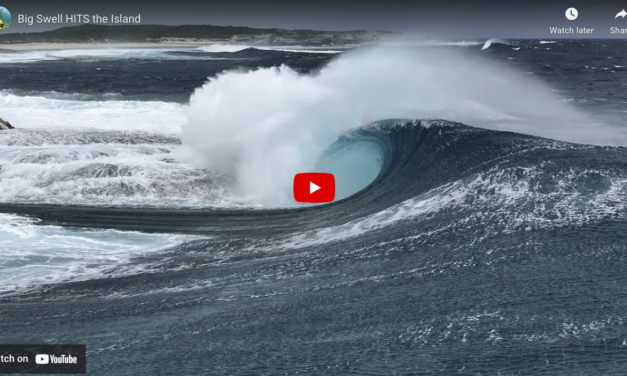
Once the swell arrived, 20-foot faces were breaking on a rock slab — a true force to be reckoned with. As this was the first time Michael, Shane, or I had witnessed this break, we were a little nervous to say the least. Standing on the cliff surveying the setup we could see the locals had dispatched a ski in the lineup and were towing into some bombs. Now, if you want to get the full experience of the Waffle House, you must eat an All-Star Special. By the same token, if you want to get the full experience of a surf trip to Nicaragua, you need to surf outer reef Popoyo while she’s hitting her crescendo. With this in the back of all our minds, we paddled out. And although completely undergunned, each of us stroked into some sizable waves that were equivalent to at least two All-Star Specials.
So if you want to go on a surf trip, you know where to go. As you can see from my capitalistic breakdown, popularities amongst surfing locales shift due to different factors. Maybe the next trendy surf destination will be in Scandinavia somewhere. Who knows? But remember, if you go to Nicaragua, do not hesitate to surf outer reef while it’s maxing. And before you depart, please slide into the Waffle House and grab the much-heralded All-Star plate. It’s a great standard of measure for surf.